In October 2024, in a symbolic move, Nicaraguan president Daniel Ortega broke diplomatic ties with Israel. How are the Palestinian Liberation Movements involved?
PLO-FSLN historical relationship
Nicaragua played a significant role in the Israeli-Palestinian war. It was one of the few Latin American countries to have had such a decisive historical impact on both the Zionist leaders and factions of the Palestinian national movements. Since 1937, the country has been ruled by the wealthy Somoza family through a coup d’etat (backed indirectly by the United States) to wipe out a left-wing resistance led by Augusto Sandino, a Nicaraguan revolutionary guerrilla (who succeeded in pushing out US occupying troops from Nicaragua in the 20s).
The first contact between the FSLN and the Palestinian resistance happened during the Tricontinental First Conference in La Havana, in 1966 (which fostered deeper ties among the Third World nations against colonialism and economic imperialism). In 1969, Benito Escobar, one of the founding members of the FSLN, with the intermediation of Cuba, met three PLO representatives in Mexico City. The meeting aimed at deepening the military ties between the FSLN and the PLO, which let FSLN militants be trained by Palestinian revolutionaries in Jordan, Algeria and Lebanon (the first contingent arriving in Lebanon in 1969). Indeed, during the 1960s, the FSLN did not have the military experience and necessary support to continue to confront the Somoza regime.
During an interview with the Kuwaiti newspaper Al Watan, in 1979, the Sandinista’s spokesperson Jorge Manda stated that “Nicaragua has a bloodline with Palestine” – many Nicaraguan revolutionaries joined the Palestinian fight during the Black September in 1970 and, eventually, would lose their lives in Amman. Furthermore, the FSLN representative, Oscar Turcios, and the Argentine militant, Joe Baxter, met with the Greek revolutionary official Michel Pablo in Paris in 1969. Pablo had secret contacts with the PDFLP’s leader, Nayef Hawatmeh, and put the two Latin American guerrilla leaders in contact with him. He had agreed to let the FSNL members be trained in his camps. Hence, in 1970, a small group of Nicaraguan guerrilla forces trained under the PDFLP protection at a Palestine refugee camp near Amman, in Jordan. However, the FSLN’s presence in Jordan lasted just a few months since they were unsatisfied with the military training.
Once again, Oscar Turcios met with Pablo in Paris; yet, this time, the Greek leader found a way to search for an alternative by looking at George Habbash, the Palestinianleftist leader of the PFLP, a fervent advocate for a one-state solution in Palestine. Habbash was willing to host Nicaraguan guerrilla members in his training camps in Jordan in exchange for their participation in the PFLP military operation (including hijacking operations). In this context, it is important to underline that the period from 1968 to 1972 was a period of intense hijackings with around 326 operations worldwide. Habbash would state that an airplane hijack would have more political resonance than simply killing a hundred Israeli soldiers. Estimates pointed out that around 12 to 150 FSLN Nicaraguan revolutionaries were sent to the Middle East (although a former Israeli intelligence officer, in Nicaragua, reported that at least 150 Sandinistas were trained at PLO camps run by the PFLP in the 70s).
Among them, the name of Patricio Argüello Ryan was one of the most relevant in the Nicaraguan-Palestinian ties. Argüello has been a prominent Marxist-Leninist Nicaraguan American citizen and FSLN militant who trained in Jordan. In the 60s, Argüello traveled throughout Latin America to get closer to the Third World movements, and his leftist affiliation with Marxism led him to adhere to the Sandinista movement. He is well known for his contribution to the Palestinian resistance by participating in hijacking operations. In 1970, the Dawson’s Field hijackings would be a turning point in the FSLN-PLO relations: in September, members of the PFLP faction successfully hijacked four aircraft bound to New York and London, 3 of which were forced to land at Dawson’s Field, a desert area near Zarqa, in Jordan. The fourth one would be diverted to El Cairo. However, a fifth aircraft, the AI Flight 219, from Tel Aviv to New York, with a layover in Amsterdam, was unsuccessfully hijacked by Patrick Argüello and Leila Khaled, a Palestinian activist and the first woman to hijack an aircraft who participated in the Palestinian resistance. They tried to reach the cockpit but were unsuccessful. AI Flight 219 made an emergency landing at London Heathrow Airport, where British police arrested Khaled, and Argüello, who had been shot several times by the aircraft security forces, died in the ambulance. Argüello will be remembered as a martyr and the one who sacrificed his life for the Palestinian cause against Zionism by the PFLP.
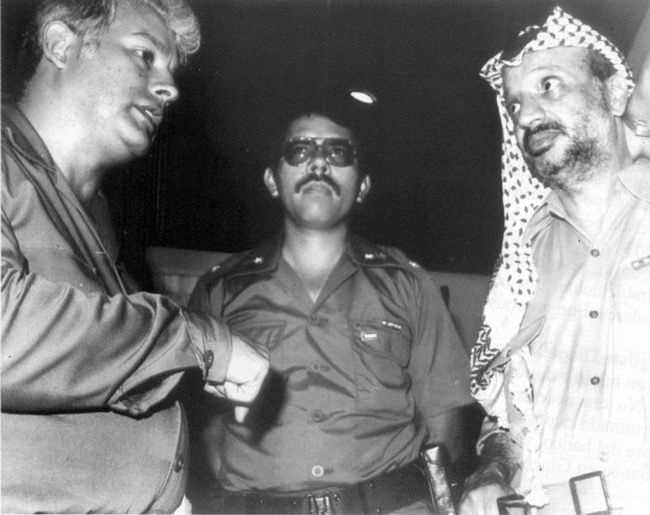
However, let alone the Argüello-PFLP hijacking operations and the training period, according to many critical studies, especially those provided by the Center for International Security, the Palestinian-Nicaraguan relationship did not work formally until 1979, when a massive popular insurrection succeeded in overthrowing the Somoza family in Nicaragua. The PLO sent significant military aid to the FSLN as a sign of solidarity. In 1979, after the FSLN seized power, an intense diplomatic period started for Nicaragua, whose new government sought international recognition. During the 80s, the PLO’s leader decided to send its pilots to Nicaragua (although it was repeatedly dismissed by the PLO) to back the FSLN activities as well as providing economic aid to Nicaragua (in 1981, Arafat announced a $10 million loan and contributed to the formation of a Nicaraguan airline by donating several Boeing 727 aircraft). In July 1980, Yasir Arafat also attended celebrations in Managua on the first anniversary of the Sandinista victory. Additionally, in the same year, the first PLO embassy was set in Managua and the military aid – also offered by other Arab countries such as Qadhafi’s Libya – continued due to the newborn Contras’ resistance affiliated with the Somoza, trained by Israel, and supported by the United States (whose policymakers allegedly accused Nicaragua of being a new base for PLO terrorism – although, officially, there has been just one evidence of PLO terrorist attacks in Latin America against Israel’s embassy in Paraguay in 1970, with two secretaries shot, being the first attack against an Israeli embassy worldwide).
The relation between the FSLN and the PLO marked a significant turning point in how Latin America has been perceived in global affairs. Despite the Third World theses of solidarity provided a wider framework in which the PLO acted in Central America, it is worth stating that the PLO’s involvement in the region was partly motivated by strategic reasons: to counterbalance the Israelis’ presence in Central America (not only in Nicaragua, but also in nearby countries). Indeed, during the Cold War, Israel found a key partner in the wealthy Somoza family in Nicaragua, whose weapon imports from Israel accounted for almost 98% of their trade partnership. In this context, the PLO played a major role in counterbalancing Israel’s actions in the region by being directly engaged in military operations alongside FSLN militants. Eventually, the FSLN-PLO longstanding relationship can be resumed in a famous quote by Yasir Arafat, who once stated that “The road to Jerusalem leads through Managua”.
Future relationship
In October 2024, President Daniel Ortega and previous member of the FSLN announced the end of diplomatic ties with Israel, calling the state a “fascist and genocidal one” at a time when the Palestinian death toll rose to 42,000 people. However, despite the symbolic diplomatic spat, their relations have always been nonexistent. Previously, Nicaragua also submitted a request to end Germany arms export to Israel in March 2024 and joined South Africa’s proceedings against Israel for committing genocide in the Gaza Strip in December 2023. Yet, on 4th April 2025, after intense pressures among Jerusalem’s critics and a possible move from Washington, Managua withdrew from the proceedings issued by Pretoria, but the reasons remain unclear. In the long run, however, the relationship between the Nicaragua and Palestine are due to stay solid.