Mexico is one of the United States’ closest partners. However, the country now bears the brunt of Trump’s “big stick” diplomacy.
The 26th president of the United States of America, Theodore Roosevelt, was used to repeating: “Speak softly and carry a big stick, you will go far”. This aphorism converted into a new political approach during Roosevelt’s foreign policy in the early XX century. Under this new foreign policy of the “Big Stick,” Roosevelt shaped his diplomatic ties with Latin America, enforcing the Monroe Doctrine. The idea of negotiating peacefully while having a strong position – threatening the counterpart militarily – in case things go wrong seems to be Trump’s second-term approach to international affairs.
Trump’s foreign policy has not changed drastically from his first presidential term in 2016. Under Mexico’s President Peña Nieto and the new AMLO administration in 2018, President Trump maintained similarities: he threatened US-Mexico diplomatic ties after promising massive deportations of undocumented immigrants under his “Remain in Mexico” program (also known as the Migrant Protection Protocols, MPP), in 2019. The program aimed at curbing migrant flows near the southern border with Mexico. The asylum seekers – mainly from Central America and Mexico – could be deported back to Mexico anytime while waiting for their cases to be considered by the United States immigration courts. Some critics have judged this program as inhumane and violating international law about the protection of human rights.
Trump threatened to impose tariffs on the country amid a peak of migrant arrivals from Central America – back in 2019 and when COVID-19 was about to spread – had Mexico not curbed migration. The country was ready to impose retaliatory tariffs on the United States. Eventually, Mexico agreed to enforce its immigration laws under US pressure. As a matter of fact, during his first term, Trump vowed to end the North America Free Trade Agreement, which he considered “the worst trade deal ever,” replacing it with USMCA. During his nomination later in 2025, US Secretary of State, Marco Rubio, stated that Mexico’s economy was strong and remained pivotal for US interests.
In Trump’s second term, which started back in January 2025, he immediately kicked off a trade war on Mexican, Canadian, and Chinese imports, imposing a 25-percent tariff on all goods announced even before swearing as President of the United States. Sheinbaum kept on dialogues with Trump but planned countermeasures and retaliatory tariffs, amid Trump’s concerns about border security and, especially, fentanyl drug trafficking in the US. However, negotiations successfully delayed US tariffs on Mexican goods, especially on auto imports, after Sheinbaum agreed to boost border security by deploying 10,000 additional soldiers to Mexico’s northern border (although underscoring that 70% of firearms for criminal activities come from the US).
Claudia Sheinbaum appeared to maintain a diplomatic approach, suggesting that she would not respond immediately (although countermeasures to shift and diversify Mexico’s economic relations, proving that US tariffs continue, were announced). After a phone call between the two presidents early this March 2025, Sheinbaum fanned a strong nationalist sentiment demonstrating her unwillingness to be subdued to Trumps’ pressures, showing him how ramping up border security was yielding some concrete results. Mexico’s president is still taking time, hoping for a de-escalation of the trade war that other trade partners – mainly Canada and China – have already begun.
Opportunities and Strengths
Trade between Mexico and the United States reached more than $800 billion in 2023 and 2024, making Mexico the most important US trade partner in the world, surpassing China and other advanced countries. However, COVID-19 has taken its toll on boosting a new trade era, making the two countries even more interconnected and interdependent: key US States, relying on imports from Mexico, are the ones bordering with it – which also rely best on their exports to the country –. New Mexico, Arizona, Texas, and California are just some significant examples. Mexico has been Arizona’s biggest trading partner, with an amount of $20 billion in trade every year; trade with Texas is also responsible for an astonishing $270 billion in commercial activities creating over five hundred thousand jobs.
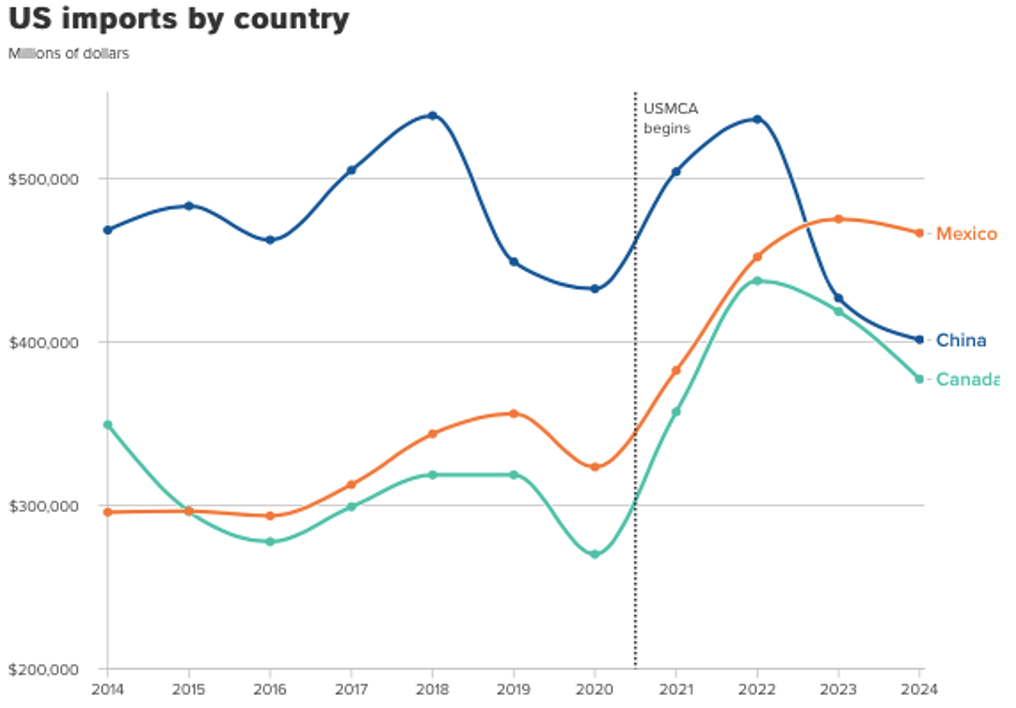
Culturally and economically, all the communities living near the Mexico-US border are well interconnected with each other, with great bilateral trade relations. What is most worth noticing is that the North American integration (through the US-Mexico-Canada regional industrial system able to produce complex goods giving to the transfer of knowledge) contributes 17.9% of the world GDP – almost one-fifth of the entire world’s GDP -. After NAFTA entered into force in 1994, it has always secured economic prosperity for its small and large businesses: trade with key partners Canada and Mexico reached $1.3 trillion so far, also securing 14 million jobs in the United States.
As we have just seen, Mexico’s trade relationship with the US (and Canada) is pivotal: the Latin American country provides the US with more than 80% of its exports; on the other hand, the US provides just 40% of Mexico’s imports, being this relationship quite asymmetrical. Despite the US being a huge economic superpower, Mexico is its most important trade partner, gaining benefits from this relationship in terms of accessing the US markets and protecting the United States from becoming too dependent on goods from its trade rivals. As we have also mentioned, the strengths and opportunities of the US-Mexico bilateral trade relationship outweigh the drawbacks: this is a strategic economic alliance, vital for both.
President Sheinbaum will moderate Trump’s antagonism, remaining committed to enhancing cooperation with the United States in the framework of the NAFTA/UMSCA principles while positioning Mexico as a valid regional player. Although a trade war is possible sooner or later, it is unlikely a complete US’ disengagement from USMCA. Simultaneously, President Sheinbaum has prepared an ambitious “Plan Mexico” aimed at bolstering national investment and development by enhancing imports substitutions and the creation of new jobs. The plan also aims at promoting nearshoring activities and launching a new “Made in Mexico” program attracting foreign investment while diversifying Mexico’s trade partners and maintaining economic competitiveness, stable interest rates and fiscal consolidation.
Threats and Weaknesses
It is worth noticing how Trump showed second thoughts when imposing 25% tariff on imported vehicle parts and vehicles from Mexico back in February 2025 (that should have taken effect by March 4). He purportedly delayed the implementation of the tariff until April 2, after pressures coming from big automaker factories in the United States worried about economic repercussions: the average cost of a car would skyrocket up to $10,000, which could prevent consumers from buying US cars. This is because the final car is assembled in the United States, but its components are not: they came from Mexico and Canada primarily, and a 25% duty would have significant weight (being even more expensive to simply repair a vehicle) since car components cross border multiple times before being sold to consumers.
By menacing the imposition of these “import taxes,” it is not clear what the Trump administration hopes to achieve: multiple issues are on the table, starting from migration and drug trafficking. Trump may pressure the Mexican government to do more in terms of security. He also wishes to turn production “American” (onshoring production), convincing foreign industries to produce in the United States and promising them lower taxes than the ones they will pay under other circumstances.
However, tariffs are import taxes that are deleterious for domestic buyers who will pay much of the tariff. They are tailored to protect local industries from imports, making them more expensive and pushing consumers to shift to local industries (buying at a higher price than they would internationally). Tariffs destroy the comparative advantage of a country, driving local industries to produce, at a higher price, what they cannot produce best. Nevertheless, the auto sector could shut down assembly lines and people would lose their job. In the short term, import taxes could boost inflation and slow economic growth for the United States and Mexico which would lose the most plunging into a severe recession in the long run.
Final consideration
President Sheinbaum repeatedly invoked Mexico’s unalienable sovereignty and a robust national unity and solidarity. Meanwhile, the US Republican President is strong-willed and considers that import taxes – tariffs – would enrich the United States and its citizens by also leading to significant investments in the country, boosting economic growth in the long-run. However, today, his plans not only confuse and alienate the relationship with his historical allies, but, domestically, tariffs are generating apprehension for a possible inflation and a slower economic growth. Eventually, in the long term, a trade war appears to be plausible at the expense of both the United States’ citizens and the Mexican’s ones who would suffer the most from tariffs, since for more than 30 years Mexico set its trade and integration in North America; and, now Mexico’s central bank predicts a 0.6% GDP growth for 2025 up from 1.2% the previous year.