Abstract
Kaliningrad has become a growing point of tension between Russia and NATO, as increased Allied military activity, calls for greater pressure on the exclave, hybrid warfare, and Russian warnings of a possible nuclear response have raised concerns about further escalation in the area.
Introduction
Kaliningrad is a Russian city and oblast on the Baltic Sea coast, located between Poland and Lithuania. Formerly the German city of Königsberg, it came under Soviet administration after the Second World War following the Potsdam Conference in 1945, and was incorporated into the Russian Soviet Federative Socialist Republic and renamed Kaliningrad in 1946.
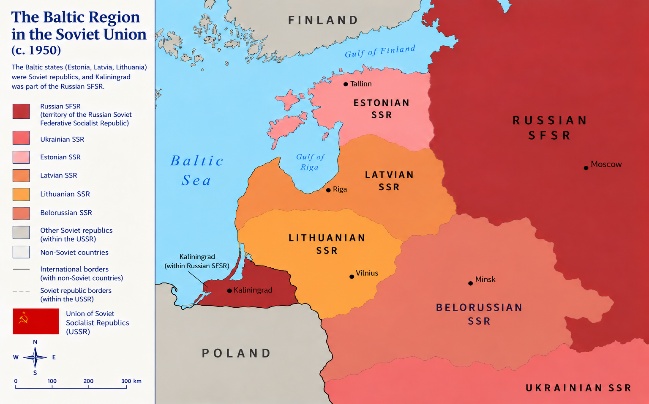
Image: AI-generated
Kaliningrad was connected to the rest of the USSR and the Russian SFSR through other Soviet republics, as shown on the map above. Consequently, after the dissolution of the Soviet Union in 1991, it became an exclave of the Russian Federation, and after Poland and the Baltic states joined NATO in 1999 and 2004 respectively, the Russian oblast found itself bordered by Alliance territory.
When I visited Kaliningrad in April 2026, travelling from mainland Russia, I had to fly from Saint Petersburg across the Baltic Sea, to avoid EU airspace. During my stay, I did not encounter any other foreign visitors, while my presence appeared to attract some curiosity among locals.
Although anecdotal, these observations reflected the region’s physical separation from the rest of Russia and its growing political distance from the rest of Europe.
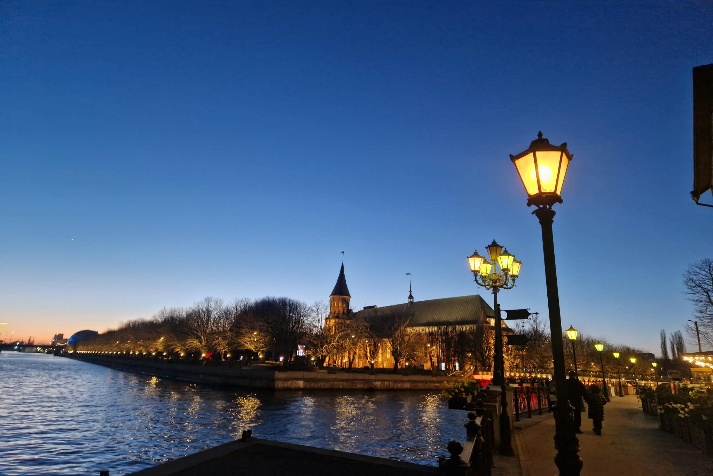
Image: View of Königsberg Cathedral, which houses the tomb and museum of German philosopher Immanuel Kant, in Kaliningrad, Russia, April 8, 2026. Photo by the author.
Its geographic position makes the geopolitcal situation particularly sensitive. With Finland and Sweden joining the Alliance in 2023 and 2024 respectively, Kaliningrad is now entirely surrounded by NATO members both by land and sea.
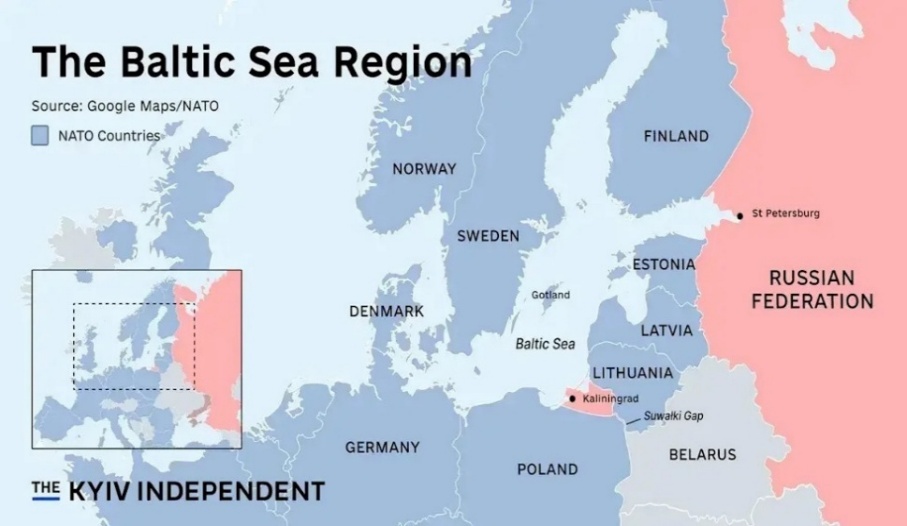
Image source: https://kyivindependent.com/estonia-bans-transit-of-grain-from-russia-belarus/
This has further increased Moscow’s concerns about the possibility of restrictions on its access to the rest of Russian territory and maritime routes.
Context
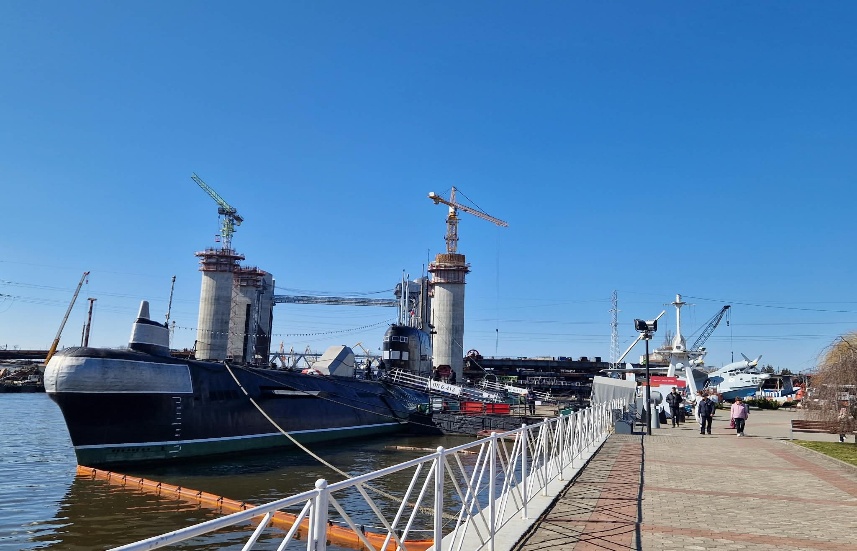
Kaliningrad occupies a strategic position on the Baltic Sea, particularly because of its military and maritime importance. It hosts Russia’s Baltic Fleet and the 11th Army Corps, as well as significant missile and air-defence capabilities, including Iskander missile systems and S-400 air-defence systems. These assets contribute to Russia’s anti-access/area-denial (A2/AD) posture, designed to restrict an adversary’s ability to operate freely in and around the Baltic region.
In recent years, tensions have increased alongside NATO military activity in the area.
On August 18, the Alliance conducted an unannounced air exercise around the strategically important Suwałki Gap, the narrow stretch of Polish and Lithuanian territory connecting the three Baltic states with the rest of NATO while separating the Russian exclave from Belarus.
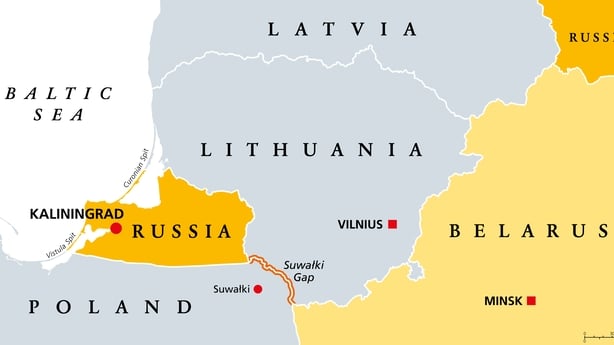
Image source: https://www.rte.ie/news/analysis-and-comment/2025/0921/1534438-suwalki-gap-nato-russia/
It was NATO’s largest air force demonstration over Poland and the Baltic Sea in years, with over 50 aircraft reportedlyin the air at any one time.
In May, Allied forces conducted Amber Shock 26 exercise near the Russian oblast, involving the Multinational Division North East, which is responsible for the defence of the north-eastern flank, including the Suwałki Corridor.
The Alliance also launched Operation Baltic Sentry in January 2025 to protect undersea communication cables and pipelines in the area. Moscow, however, has described the operation as an attempt to develop mechanisms that could restrict international shipping.
These exercises form part of a broader series of NATO activities in the region, described as deterrence and defensive actions against Russia, with additional exercises during autumn.
Political statements have added another layer to the tensions. In September, Polish Foreign Minister Radosław Sikorski called for a greater military presence around Kaliningrad, arguing that increased pressure could force Moscow to redeploy troops from Ukraine. He also said that Poland was closely monitoring the situation and claimed that the Russian exclave currently had “practically no troops.”
“So Putin knows, or assumes, that NATO is a peaceful alliance and that we will not take advantage of his local weakness,” he said. “And perhaps that is a mistake,” Sikorski declared.
Another similar declaration was released by the Lithuanian Foreign Minister Kęstutis Budrys in May, who stated that “We must show the Russians that we are capable of breaking through their little fortress in Kaliningrad.”
Consequently, in late September, Russian authorities and several Russian embassies in Europe declared that they had “information that NATO is preparing (an) air and naval blockade of Kaliningrad and Kaliningrad region.” The Kremlin has responded with forceful statements, saying that Russia had no intention of attacking NATO countries but warned that any aggression against the exclave would be met with the strongest possible response.
The embassies in the U.K., Ireland and Belgium also posted their declarations on their Telegram and X channels.
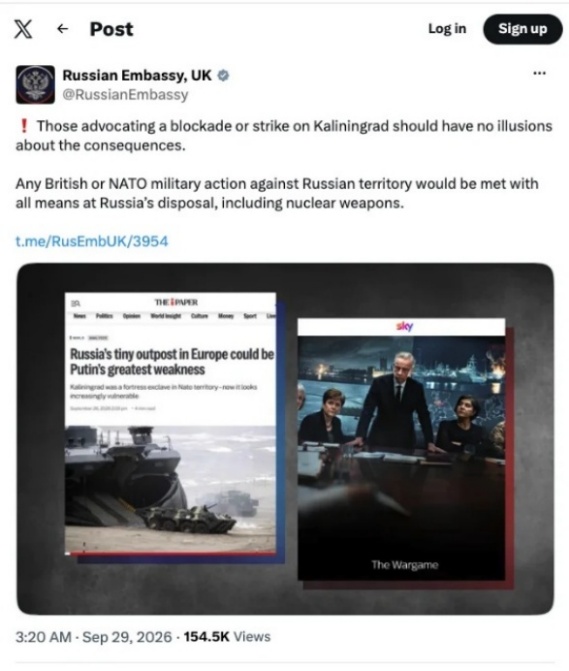
Image source: https://stateofthenation.info/?p=82142
In the attached X post, the Russian Embassy in the U.K. explicitly refers to Sky News’ fictional miniseries “The Wargame”, which simulates a military conflict between Russia and the West, including a scenario involving Kaliningrad. The embassy also cited an iNews article which describes the Russian exclave as “Putin’s greatest weakness” and discusses possible ways NATO could exert pressure on the region, echoing similar arguments made by Sikorski and Budrys.
So What
The current tensions around the Baltic, therefore, reflect the interaction of several developments, including explicit signalling from the Kremlin.
Moscow accuses the Western allies of pursuing a “dangerous and reckless” course, with a high risk of triggering a direct armed confrontation.
Reuters reported on September 30 that Russia had sent the Alliance a non-paper, warning that if they attempted to isolate the exclave, Russia could attack decision-making centres in NATO territories and use its entire available arsenal to defend its oblast, including nuclear weapons.
Meanwhile, the Alliance confirmed that it had received the document, described itself as a defensive alliance, condemned the rhetoric, and accused Moscow of attempting to intimidate Europe.
The exchange illustrates the potential for a security dilemma around Kaliningrad, as measures intended to strengthen deterrence or reinforce NATO’s position could be interpreted by the Kremlin as preparations for a more direct threat, particularly following recent calls by Western officials and media for greater pressure on the exclave.
Speculative Hypothesis
One possible interpretation is that NATO’s actions and declarations could be intended, at least in part, to force Russia to divert resources and public attention away from the Ukrainian front, with the Polish Foreign Minister’s previously reported comments appearing to lend some support to this hypothesis.
However, the effectiveness of such a strategy would depend on whether the Kremlin actually considers a significant redeployment needed, as if it can protect Kaliningrad through air and naval capabilities, long-range systems, or nuclear deterrence without moving substantial ground forces, the effect on the Ukrainian front could be limited.
The central question is therefore not simply whether pressure from the Alliance could divert Russian resources, but whether the escalation risks would outweigh its potential benefit for the West.
While this hypothesis is based on a broader combination of recent actions and declarations, rather than Sikorski’s comments alone, these factors do not necessarily indicate a coordinated NATO strategy. An alternative interpretation is that the Alliance’s actions are primarily aimed at strengthening deterrence and military preparedness.
NATO spokesperson Allison Hart stated that, “Our reading is that they want to intimidate allied public opinion so that allies stop supporting [Ukraine], while, at the same time, presenting NATO as the one that would be responsible for an eventual escalation.”
Best-Case Scenario
In the best-case scenario, the exchange of threats would not lead to a direct conflict, as both sides could recognise the risks of an escalation around Kaliningrad and avoid measures that could trigger direct military action.
Russia’s warnings could contribute to deterrence by communicating the potential costs of further escalation, while the Alliance could continue its defensive activities without crossing the threshold into direct confrontation.
Grey-Zone Scenario
A more prolonged scenario could see the Russian oblast remaining in a state of chronic tension without involving direct fire. Jamming, sabotage, maritime incidents and disputes over transit could continue to create pressure around the exclave while remaining below the threshold of a direct NATO-Russia war.
The 2022 Lithuanian restrictions on rail transportation to Kaliningrad are a useful precedent showing that restrictions on transit to the exclave are a concrete possibility.
Worst-Case Scenario
The most serious outcome would be a direct confrontation in the Baltic region, as attempts to isolate Kaliningrad could trigger a Russian military response.
In that case, if the Kremlin chose not to deploy additional ground forces, it could instead rely more heavily on long-range capabilities and nuclear deterrence. The previously reported “non-paper” appears to raise this possibility.
Conclusion
The geopolitical situation in the Baltic has changed significantly in recent years, leaving Kaliningrad in an increasingly sensitive position. With Russia’s military resources largely committed to the war in Ukraine, NATO may see an opportunity to increase leverage in the region and put further pressure on Moscow.
However, developments in that direction could risk opening a new front of conflict, with potentially serious consequences for all sides.
Any further pressure on the exclave would therefore require careful consideration of the possible outcomes, particularly given the possibility of a Russian missile or nuclear response.