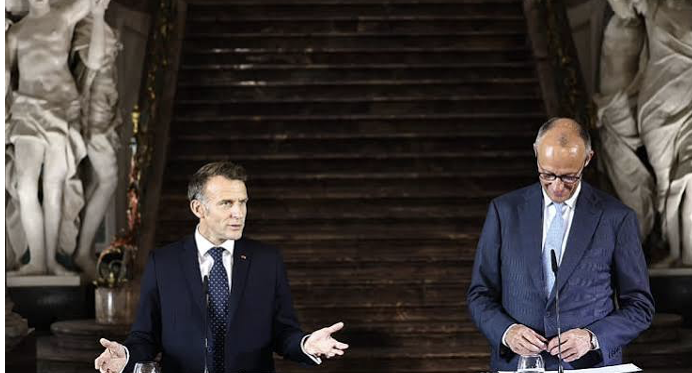
In June, FCAS, the most ambitious fighter jet programme built by France and Germany, came to an end; the two countries cannot agree on what European rearmament means in practice.
ABSTRACT
France and Germany share the goal of increasing European defence spending, but not how to turn it into real capability. Paris insists on a “European preference” that reduces dependence on outside suppliers; while Berlin prioritises speed, through industrial deals with the United States. The clearest sign of this divide is the collapse, on 8 June 2026, of the FCAS fighter jet programme, in the same stretch of months Germany signed a deal with Lockheed Martin to produce ATACMS missiles outside the US for the first time. This analysis reconstructs this divergence from primary sources and assesses what it means for European strategic autonomy in the 2028-2034 EU budget.
INTRODUCTION
Following NATO’s Hague summit (2025), where allies pledged to reach 5% of GDP in defence-related spending by 2035, and the Ankara summit (July 2026), where they announced more than $50 billion in new joint procurement, European allies committed to substantially higher defence spending. Global military spending hit $2,887 billion in 2025, though still only about 2.5% of world GDP, far below twentieth-century levels. The question is not only how much is spent, but how Europe is shifting from buying weapons to rebuilding its industrial capacity; a process measured long-term and one that entangles defence, industrial policy and transatlantic relations.
CORPUS
The Future Combat Air System (FCAS) was Europe’s most ambitious defence-industrial project: a sixth-generation fighter jet, surrounded by accompanying drones and connected through a shared digital “combat cloud”, meant to replace France’s Rafale and Germany and Spain’s Eurofighter from around 2040. Launched in 2017 by Macron and then-Chancellor Angela Merkel as a symbol of post-Brexit European defence ambition, it brought together three national manufacturers: Dassault Aviation, the French company behind the Rafale and Mirage jets, leading the fighter itself; Airbus, the Franco-German-Spanish aerospace group representing German and Spanish industrial interests, responsible for the accompanying drones; and Spain’s Indra, covering sensor and combat-cloud technology. On 8 June 2026, German Chancellor Friedrich Merz confirmed the end of the programme’s crewed-fighter component, after nine years and more than €100 billion in commitments without a single prototype ever built. An independent mediator, appointed by Merz and Macron, concluded on 18 April that a jointly developed crewed fighter was no longer feasible.
At the core of the dispute, per Euronews, was Dassault’s insistence on leading the development against Airbus’s demand for a genuinely balanced partnership. Germany is now said to be weighing membership of GCAP, the rival UK-Italy-Japan programme.
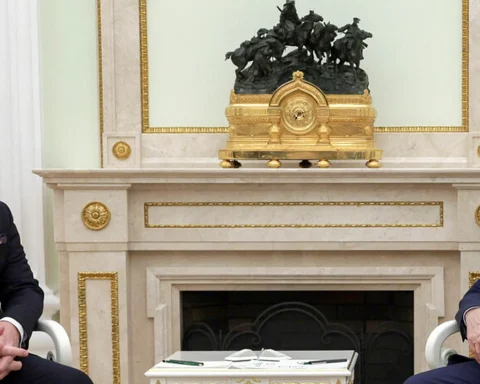
On 17 July, at the Franco-German Defence and Security Council in Brühl, the two governments tried to contain the fallout without letting it swallow the wider bilateral relationship. The official conclusion published by the Élysée does not explicitly mention FCAS; instead, it commits the two countries to “define a European collaborative combat standard” for future air systems.
The ground-systems equivalent, the Main Ground Combat System (MGCS), was not abandoned, but the wording is similarly cautious: a commitment merely to “investigate an approach for collaborative combat in a research programme” and bring it to “proof-of-concept”.
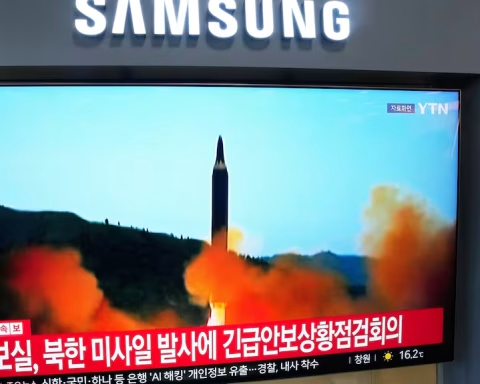
Over the same months, Germany pursued a faster, more transactional path. On 7 July, on the sidelines of NATO’s Ankara summit, Lockheed Martin and Rheinmetall signed a memorandum of understanding to produce ATACMS missiles at Rheinmetall’s Unterlüß plant; the first production of the system outside the United States, according to both companies. Rheinmetall expects output to begin in 2027, scaling to 600-800 units a year to meet European and Ukrainian demand, according to Defense News.
SPECULATIVE HYPOTHESIS
The Franco-German split is not about rearmament itself, both countries are frontline promoters, but about the allocation of resources. At the Munich Security Conference on 13 February 2026, Macron argued Europe must “reduce our dependencies through policies of European preference”; extending the principle beyond defence to AI, cloud computing, critical minerals and clean tech. The financial stakes are considerable: in its proposed 2028-2034 Multiannual Financial Framework, the European Commission has earmarked €131 billion for defence, security and space through the new European Competitiveness Fund, five times the current budget cycle’s allocation.
The “65% European content” rule often cited as a general principle is, in fact, specific to individual instruments. Under the European Defence Industry Programme (EDIP), at least 65% of the component cost of funded products must originate in the EU or associated countries. Under SAFE, the €150 billion EU loan instrument established by Council Regulation (EU) 2025/1106 of 27 May 2025, components from outside the EU, the EEA-EFTA states and Ukraine cannot exceed 35% of the end product’s component cost. It is around these specific thresholds, and how strict the next generation of EU financial instruments will be, that the real Franco-German contest plays out, not around a single overarching doctrine.
Germany does not reject the case for a stronger European industrial base, it co-signed that commitment on 17 July, but it remains more open than France to folding US technology into its rearmament, through licensed production and industrial transfers, rather than drawing a sharp line between European and non-European systems. The same tension shows up in space: Germany is developing its own military satellite constellation of roughly 100 low-Earth-orbit satellites, with Rheinmetall and OHB, separate from the EU’s IRIS² programme, recently expanded to 348 satellites following an August 2026 agreement between the Commission, ESA and the SpaceRISE consortium.
SO WHAT – Two trajectories
Scenario A — convergence forced by the budget negotiation. Key assumptions: neither Paris nor Berlin can afford exclusion from the €131 billion Competitiveness Fund; the 2028-2034 MFF negotiation becomes the forum where European-content thresholds get renegotiated rather than fought out programme by programme; Germany’s GCAP and US-facing deals proceed without formally breaking Franco-German cooperation on the items already agreed (MGCS research, missile defence, space interoperability). Impacts: industrially, a European-content threshold that ends up looser than Paris expectations but tighter than Berlin prefers, applied unevenly across EDIP and SAFE; diplomatically, the bilateral relationship survives by concentrating on lower-conflict items while avoiding new flagship joint platforms; over the medium term, a genuine FCAS successor stays off the table until well past 2030. Strategy: the EU’s more effective lever is the budget negotiation itself, not new bilateral initiatives, using the common financial instruments to narrow the gap gradually rather than seeking a single grand bargain.
Scenario B — the split hardens. Key assumptions: Germany deepens its GCAP track and further US industrial tie-ups (Tomahawk/Typhon, possible future European PAC-3 production); France pursues a more autonomous path, potentially with Dassault alone on a future national fighter; the MGCS research programme stalls the way FCAS did. Impacts: industrially, Europe’s technology base fragments into parallel supply chains rather than consolidating, visible already in the satellite duplication; diplomatically, the Franco-German axis loses relative weight as the three-way GCAP grouping gains traction as a working alternative; over the long term, Europe risks remaining structurally dependent on outside suppliers precisely in its most advanced systems, undercutting the strategic-autonomy rationale that justified the spending increase in the first place. Strategy: the realistic EU response in this scenario is to accept a multi-speed defence industrial base and concentrate common instruments (EDIP, SAFE) where compromise remains possible, rather than insisting on full convergence.
MONITORING
Five things to watch: whether Germany formalises GCAP membership in the coming months, and on what industrial terms; whether the 2028-2034 MFF negotiation shifts the 65%/35% EDIP-SAFE thresholds; whether the Tomahawk/Typhon deal clears US export approval on schedule in August and what basing and delivery details emerge; whether France signals a national successor to FCAS, confirming the end of joint ambitions; and whether the MGCS research effort actually reaches proof-of-concept on the stated timeline, or stalls the way FCAS did.