The intergovernmental commission, Druzhba oil, natural gas, nuclear fuel and Russian diesel: where Bratislava’s economic interests end and the Kremlin’s strategic opportunities begin.
Abstract
A new meeting of the Slovak–Russian Intergovernmental Commission for Economic, Scientific and Technical Cooperation, dormant since 2021, is scheduled to take place in Moscow on 25 November 2026. Bratislava has confirmed that preparations are under way; a Russian ministerial memorandum examined by POLITICO reportedly places energy supplies, nuclear fuel, and cultural and sporting exchanges on the agenda. The backdrop is sector-specific interdependence, EU legislation requiring a gradual phase-out of Russian gas, and a temporary US authorization for certain transactions involving Russian diesel. The analytical pitfall is to mistake the reopening of a diplomatic forum for the conclusion of trade agreements or an institutional break by Slovakia with the European Union. A more plausible working assessment is selective and contentious cooperation: Fico seeks national room for manoeuvre over supplies, Moscow preserves a channel within the EU, and Brussels attempts to turn energy decoupling into enforceable rules. The decisive variable will be whether any agreements reached on 25 November create legally binding commitments, and what those commitments contain. [S01–S03; S06; S08–S11]
Methodological Note
This dossier adopts an open-source intelligence (OSINT) approach grounded in primary sources, legal instruments, government statements, official statistics and independent journalistic reporting. Its information cut-off is 16 October 2026. Three categories are explicitly distinguished: documented fact, when a primary legal act or official statement is available; attributed information, when a claim comes from a document not fully accessible to the analyst but reported by an identifiable media outlet; and speculative hypothesis, when possible goals, mechanisms or future scenarios are inferred. The meeting scheduled for 25 November is not treated as an event that has already taken place, and no independent forensic authentication of the alleged 10 September Russian memorandum has been conducted. The photographs are authentic documentary images, contextualized by photographer, location and date whenever verifiable; they do not directly prove current government decisions, oil flows or new economic concessions. The diagrams and infographics are editorial reconstructions based on cited data, not satellite imagery. [S01–S13]
The difference between “more than half of Slovak gas imports originating in Russia” in the European Commission’s Country Report and “roughly one third of SPP’s supply portfolio” in the OSW analysis requires careful attention to statistical scope. These figures are not interchangeable estimates. A quantitative contract-by-contract assessment of gas types and physical flows on the date of publication is beyond the open-source dataset reviewed here. [S03; S05]
Introduction
Two Economies with Asymmetric Interdependence
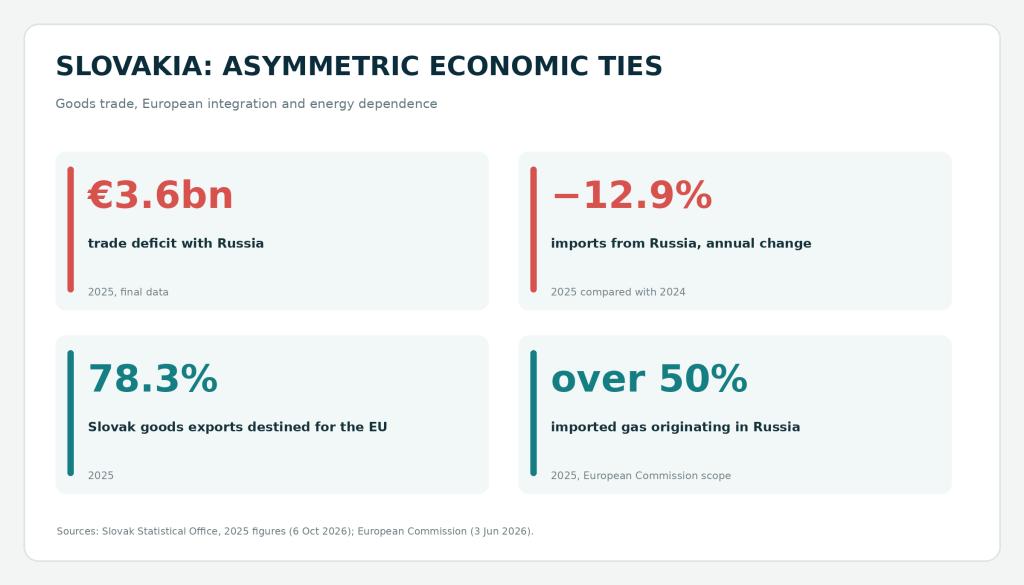
The trade relationship between Russia and Slovakia in 2026 does not involve economies of comparable size or mutual importance. Slovakia is a small, open industrial economy deeply integrated into the EU single market and European automotive, electromechanical and chemical supply chains; Russia is primarily a supplier in a limited number of strategic segments. In 2025, the Statistical Office of the Slovak Republic recorded €110.9 billion in total goods exports and €108.4 billion in imports, yielding a €2.5 billion surplus. EU member states accounted for 78.3% of Slovak goods exports, with Germany remaining the country’s leading trading partner. Russia, by contrast, was among the partners with which Bratislava ran a trade deficit, amounting to approximately €3.6 billion. Imports from the Russian Federation also declined by 12.9% compared with 2024. This divergence shows that Moscow’s importance for Bratislava does not rest on broadly balanced bilateral trade, but rather on the concentration of certain energy and industrial inputs. [S04]
For Russia, sales to Slovakia constitute a limited share of its overall foreign trade. For Slovakia, however, uninterrupted access to oil, gas and elements of the nuclear fuel cycle can have a disproportionate effect on costs, prices and industrial continuity. The asymmetry therefore concerns the replaceability of infrastructure and the technical timescales of transition more than the headline value of bilateral trade. According to the European Commission’s Country Report, over half of the gas imported by Slovakia in 2025 still originated in Russia, and Russian crude delivered through Druzhba retained a major role. The long-term oil contract cited by the Commission extends to 2029. [S03]
Robert Fico’s government frames these vulnerabilities within a self-described pragmatic foreign policy that seeks economic relations with multiple actors, including Russia. This strategy nevertheless operates within Slovakia’s EU and NATO obligations. The geopolitical question is therefore not whether Slovakia can “choose Russia” as a trading substitute for the European Union: the figures show otherwise. The question is whether energy interdependencies can persist and be prolonged in ways that turn them into diplomatic leverage. [S03–S05]

The Political Shift: From Orbán to Fico
Viktor Orbán’s electoral defeat in Hungary in 2026 altered the political constellation of governments most sceptical of the EU’s prevailing approach to Moscow. This development raises Fico’s visibility, but it does not automatically make Bratislava a replacement for Budapest. An assessment by Poland’s Centre for Eastern Studies (OSW) highlights a Slovak government that often employs rhetoric favouring dialogue with Moscow while maintaining substantial cooperation with the United States in defence and nuclear energy. Its policy does not, therefore, amount to a wholesale realignment of Slovakia with Russia. [S05]

Corpus
The Intergovernmental Commission: Timeline and Scope
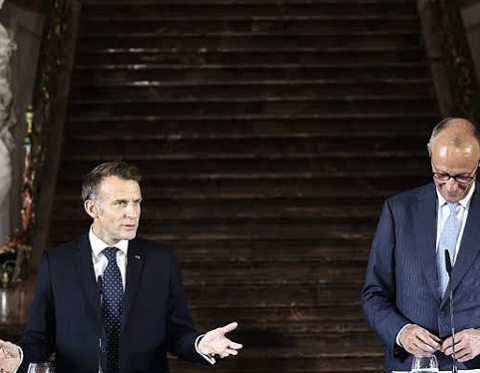
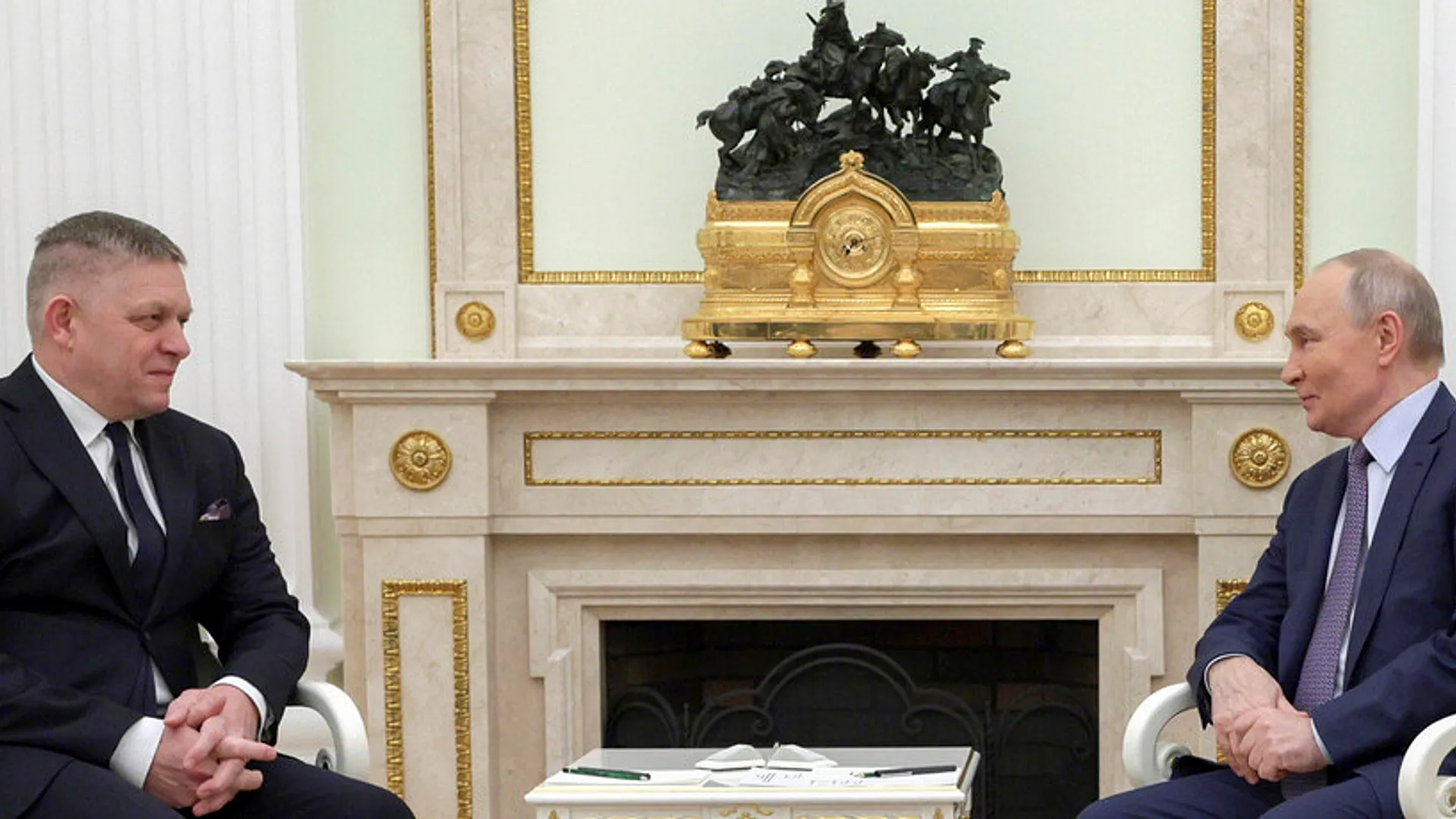
The Intergovernmental Commission for Economic, Scientific and Technical Cooperation held its twenty-first meeting in Bratislava on 12 November 2021. Its activities were subsequently suspended following Russia’s full-scale invasion of Ukraine in February 2022. In May 2026, the Slovak government appointed Foreign Minister Juraj Blanár to head its national delegation. On 20 August, Blanár discussed organizational aspects of the commission’s revival by video conference with Russian co-chair Valery Falkov. Slovakia’s Foreign Ministry published an official statement confirming these contacts and specifying the stated aim of convening a meeting in autumn 2026. [S02]
On 15 October, POLITICO reported on a Russian government memorandum dated 10 September, which initially indicated 26–27 October as a possible meeting window. Subsequent Slovak reporting stated that Fico had given 25 November 2026 in Moscow as the planned date. The difference between the initial and subsequent timetables is consistent with an evolving organizational process and, absent further evidence, should not be interpreted as proof of negotiating disagreements. The date reflects an announced intention, not a meeting that has already occurred. [S01; S11]
According to the memorandum reviewed by POLITICO, the dialogue may cover oil, gas, nuclear supplies, agriculture, tourism, culture and the treatment of Russian athletes. These subjects are attributed to the Russian document; they are not agreements already approved. Including sport in the possible agenda would matter for symbolic diplomacy, but is insufficient grounds for inferring a coordinated clandestine influence campaign. [S01; S11]

Oil: The Druzhba Test and the Adria Alternative
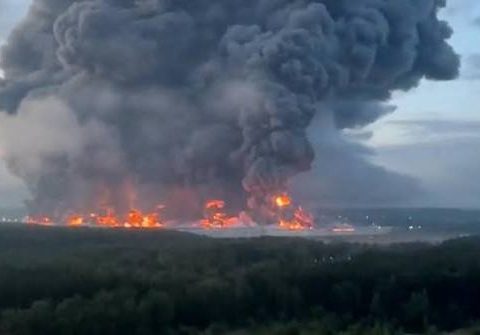
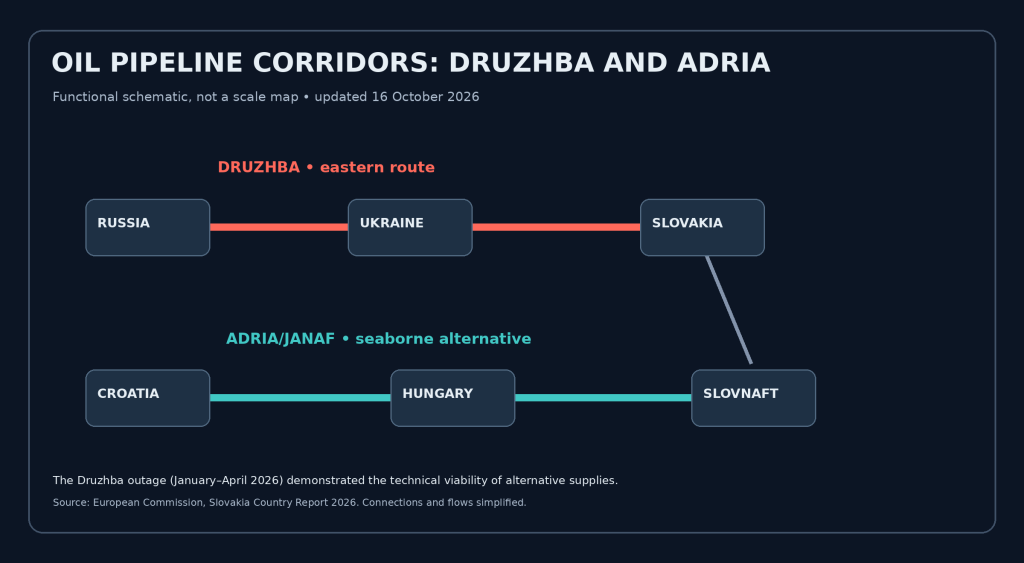
The Druzhba corridor links Russian production and pipeline networks to Central European markets across transit territories, particularly Ukraine. Slovakia has historically adapted part of its refining industry to crude supplied through that system. The Slovnaft refinery in Bratislava is therefore an important piece of infrastructure in understanding oil-sector interdependence. Yet the dependence is not absolute: another corridor begins at the Croatian oil terminal of Omišalj on the Adriatic Sea and allows deliveries towards Hungary and Slovakia via the Adria/JANAF network. [S03]
The strongest practical evidence comes from the suspension of Druzhba deliveries between 27 January and 23 April 2026. In its June report, the European Commission noted that Slovak supply security was maintained through increased deliveries of non-Russian crude along the Adria route, which even enabled emergency stockpiles to be replenished. This is documentary evidence of the technical feasibility of an alternative supply route under the conditions described. It does not prove that all remaining challenges concerning tariffs, crude-grade compatibility, refinery adaptation and permanent capacity availability have been resolved. [S03]


Gas: Systemic Dependence, Diversification and EU Legal Disputes
Gas follows a different dynamic from oil. Since the halt of Russian gas transit through Ukraine at the end of 2024, Bratislava has had to redirect part of its procurement. The Commission’s 2026 report describes lower national gas demand than in 2022 and the expansion of SPP’s supplier portfolio beyond Russia. The Commission’s figure of more than half of imported gas originating in Russia in 2025 must be compared with OSW’s lower estimate for the Russian share within SPP’s own supplies. Without consistently defined denominators, the gap rules out a single “definitive” percentage for every category of gas imports. [S03; S05]
The European legal framework is more clearly defined. Regulation (EU) 2026/261 establishes a phased regime for Russian gas imports, with different deadlines for liquefied natural gas (LNG), pipeline supplies and pre-existing contracts. For pipeline gas under long-term contracts, the reference deadline is 30 September 2027, subject to a possible extension to 1 November 2027 under specific conditions. For Russian LNG under existing long-term contracts, the deadline is 1 January 2027. Political opposition from Slovakia may seek exceptions, raise legal challenges or slow future decisions requiring unanimity, but it cannot, acting alone, suspend the effect of EU law already in force. [S06]
Nuclear Fuel: A Technological Dependency That Takes Longer to Untangle
Slovakia operates Soviet-designed VVER-440 reactors at Bohunice and Mochovce. Diversifying fuel supplies for these plants entails design work, compatibility assessments, industrial qualification and nuclear safety licensing. It cannot be equated with simply selecting a different supplier of petroleum products. Slovenské elektrárne’s prospectus discusses historic long-term contracts with TVEL and diversification arrangements with Westinghouse and Framatome. [S12]
On 9 April 2026, Framatome and four VVER-440 nuclear operators, including Slovakia’s Slovenské elektrárne, announced an agreement to advance the development of European-made fuel. At the time of the statement, the project remained at the design stage, with testing and licensing procedures planned for the future. This is a verifiable diversification pathway, but not yet a complete end to the previous dependency. [S07]

Industrial Cooperation: The Importance of Slovnaft
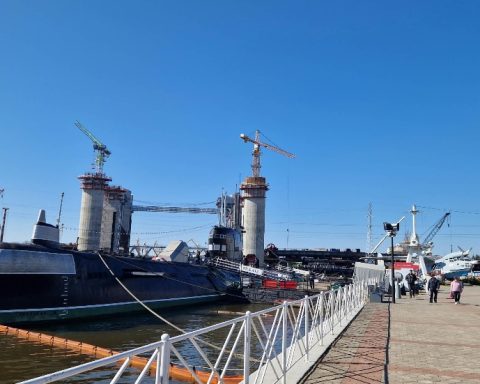
The Slovnaft refinery is an emblematic example of how infrastructure geography can shape diplomatic negotiations. Refining and petrochemical facilities require reliable feedstock, transport contracts and investment to accommodate different crude blends or altered operating processes. Any Russia–Slovakia oil agreement emerging in November should therefore be assessed not just as a geopolitical decision, but also in terms of actual industrial economics, process adaptations and applicable restrictions. Historical site photographs depict real infrastructure, but cannot attest to current operating conditions. [S03; S04]

Russian Diesel and the United States: Contrasting Sanctions Policies
On 9 October 2026, the US Treasury’s Office of Foreign Assets Control issued General License 135, authorizing specified transactions related to the sale, delivery, unloading and importation of diesel originating in the Russian Federation. Around the same time, Reuters and the Associated Press reported Donald Trump’s announcement that Russia would supply more than 300,000 tonnes of diesel to US and international markets, with additional volumes envisaged in subsequent months. The US measure is therefore real and verifiable, but sector-specific and temporary; it is not a wholesale lifting of sanctions on Moscow. [S08; S09; S13]
On 15 October, Reuters reported the resumption of exports and the tracking of a tanker carrying approximately 40,000 tonnes of diesel from Primorsk towards Morocco. This is a valuable detail for OSINT discipline: it documents a shipment heading to an international market, not the arrival in the United States of the volumes announced by Trump. Nor does it establish a coordinated arrangement between Washington and Bratislava. The coexistence of different European and American policies demonstrates how energy costs and domestic political cycles can shape sanctions implementation. [S09; S10]
The Hungarian Factor and Fico’s Diplomatic Architecture
The change of government in Hungary following the end of Orbán’s long period in office makes Fico a more visible European interlocutor advocating dialogue with Putin. Nonetheless, Slovakia’s posture is marked by an unstable balance. Decisions to strengthen its air force through US procurement and to cooperate with Western nuclear partners show that Bratislava has not replaced its NATO–EU anchoring with a Russian alliance. An assessment of the Kremlin’s interests should therefore look for targeted opportunities to shape negotiations rather than total Slovak adoption of Moscow’s strategy. [S05]
Speculative Hypothesis
Energy Diplomacy as a Tool of Selective Erosion
Hypothesis H1 — Stabilizing Economic Relations. Moscow may seek to safeguard remaining trade flows and reduce the risk of permanently losing the Slovak market. In this interpretation, the commission would mainly have a technical and commercial role. Supporting indicators would include minutes addressing supply arrangements, tariffs, payment mechanisms and contract continuity, without broader political demands. Compatibility with EU rules would remain the principal constraint. [S01–S03; S06]
Hypothesis H2 — Political Influence through Infrastructure Dependence. The Kremlin may exploit the talks to amplify calls within the EU for exemptions or extensions to the timetable for replacing Russian supplies. This hypothetical mechanism requires neither corruption nor clandestine coordination: it could operate through economic incentives, price differentials, continuity of supply and political messaging. Verification would require evidence of contractual concessions, joint statements and actual votes in EU institutions. [S03; S05; S06]
Hypothesis H3 — Low-Cost Diplomatic Normalization. Moscow may emphasize culture, tourism, education and sport to make the gradual restoration of political ties appear routine. In this scenario, the forum’s symbolic value would exceed its immediate commercial outcomes. However, the available evidence does not justify automatically classifying such activities as illicit influence operations. [S01; S11]
These three hypotheses are not mutually exclusive, and reliable numerical probabilities cannot currently be assigned to them. The discriminating test will be to compare public statements, signed documents, measurable trade flows and any requests to amend EU rules after 25 November.
So What
Best-Case Scenario — Dialogue Within European Rules
The commission meets and agrees predominantly technical cooperation compatible with Slovakia’s obligations. Bratislava uses the contacts to manage the transition without halting the expansion of alternative supplies. Moscow gains diplomatic visibility but no substantive derogation from EU rules. Impact: less immediate friction, supply continuity and manageable reputational risks. Strategy: transparently publish agreements, monitor legal compliance and accelerate industrial investment in diversification.
Stability Scenario — Selective Cooperation and Persistent Friction
Fico maintains pragmatic relations with Moscow, criticizes the EU’s energy decoupling policy and preserves defence ties with NATO and the United States. Russia retains an institutional channel without prompting Slovakia to switch geopolitical camps. Qualitatively, this scenario is most consistent with the available evidence. Impact: regulatory uncertainty and recurring supply negotiations, but no institutional rupture. Strategy: distinguish the defence of competitive energy prices from dependence on a single supplier, and scrutinize tangible outcomes rather than political rhetoric alone.
Worst-Case Scenario — Regulatory Conflict and Political Fragmentation
New bilateral arrangements generate commitments incompatible with EU restrictions or encourage several governments to pursue postponement strategies. Trade disputes develop into legal and diplomatic conflicts; European fragmentation may strengthen Moscow’s bargaining position on selected issues. Impact: greater political risk, possible infringement proceedings, obstacles to joint decisions and volatility in supply costs. Strategy: clarify legal requirements in advance, target compensation for transition costs, plan alternative capacity and monitor contractual terms.
Implications for Italy
Italian industrial supply chains are connected to Europe’s automotive and components market, sectors of central importance to Slovakia’s economy. The competitiveness of refining and energy-intensive industries in Central Europe can affect intermediate prices and sourcing networks. Diplomatically, Rome has an interest in preserving the EU’s ability to take joint decisions without allowing disputes over prices and supply security to become purely ideological. Italy can encourage infrastructure investment, multi-supplier contracts and resilience instruments while separately evaluating sanctions effectiveness, industrial costs and European security obligations. The reviewed sources do not identify any Italian agreements directly connected to the planned Slovak–Russian meeting. [S03–S06]
Conclusions
Short Term: A Meeting Still to Be Verified
As of 16 October 2026, the strongest evidence concerns the publicly stated intention to revive the commission and the plan to meet in Moscow on 25 November. The Russian memorandum is a reported indication of the agenda, not a package of decisions already signed. Renewed dialogue alone does not mean Bratislava has departed from EU foreign policy or automatically violated restrictions.
Medium Term: Infrastructure Is the Source of Leverage
The real tension lies between Slovakia’s need for affordable and reliable supplies and Europe’s determination to reduce structural dependencies on Russia. The 2026 Druzhba interruption confirms that technical alternatives exist, while the nuclear fuel process shows that some diversification efforts require more time. Washington, meanwhile, has established a specific exception for Russian diesel: Western policy is not entirely uniform.
Long Term: Measure Outcomes, Not Statements
The Kremlin could achieve a result without turning Fico into an all-purpose strategic ally: preserving economic relations and a negotiating channel capable of weakening the consistency of Europe’s approach could be sufficient. Conversely, if the EU succeeds in making alternative supplies economically sustainable, Moscow’s ability to exert influence through infrastructure would diminish. The analytical conclusion is therefore conditional: the actual trajectory will depend on the substance and legal compliance of any future agreements.
Variables to Monitor
On 25 November, analysts should verify whether the meeting actually takes place, who attends, and what minutes and signed documents emerge. In the following weeks, any commitments should be compared against Regulation (EU) 2026/261, the shares and origins of energy imports, investments in the Adria corridor, the timetable for licensing alternative nuclear fuel, and Slovakia’s positions in EU Council negotiations. Regarding the transatlantic dimension, it will be essential to distinguish diesel tonnage announced from tonnage actually delivered, while monitoring changes to General License 135 and tracing shipments. Observable movement in these variables will be more meaningful than diplomatic rhetoric.